|
Our world is covered with plants, and we are
surrounded. This list looks at killer plants on an entirely new level of
lethality. It’s not just picking petals or tasting berries that can
kill. In some cases, just approaching the plant is enough to die. In
this terrifying account, we will look at the sight-robbing potential of
Giant Hogweed, the bizarre neurotoxic plant that can make you rob your
own house, and the explanation behind Biblical legends of blood filled
waters.
|
|
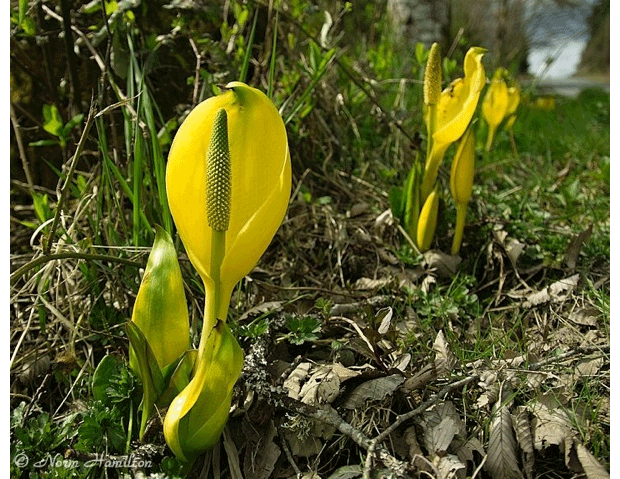
Skunk Cabbage
Skunk Cabbage is a huge, foul smelling North American member of the
Aurum family. Native to swamps, the odor of the plant is often mistaken
for an irate skunk until the huge golden or purplish flowers are seen
emerging from the leaves. The appearance of the plant is like an alien
artifact. Although certain parts of the Skunk Cabbage were found to be
edible by Native Americans, it should be known that death from severe
calcium oxalate poisoning may result from consuming the wrong parts in
excessive quantities. The calcium oxalate is an extremely corrosive
toxin that burns into the flesh, and may shut down organ systems. The
author misunderstood a gardening book and tried a flowerhead. The result
was extreme burning of the mouth and throat, serious illness for several
hours, and two days of difficult swallowing. |
|
 |
|
Buttercup
Buttercup is by far the most innocent looking plant on this list. It is
also one of the most ubiquitous, and among the more deadly garden
plants. Buttercup commonly grows in grassy patches with poor drainage,
and may frequently be found by children who use it in games that involve
touching it to the skin. The goal is to experience a momentary red mark
on the skin, as the brilliant yellow flowers release a toxin induces
temporary rash symptoms. Buttercup is far more dangerous, however. The
plant is capable of poisoning grazing animals that eat it, causing
serious gastrointestinal toxicity. Ingestion by humans may result in a
painful death resulting from organ and nervous system intoxication.
Beauty is clearly in the eye of the beholder, not the handler of this
killer flower. |
|

|
|
Giant Hogweed
Giant Hogweed is truly the plant of nightmares. While many plants are
toxic by ingestion, Giant Hogweed causes horrendous damage to humans
just by mere skin contact. Looking like an emergence from an alien
planet, the Giant Hogweed can only destroy a human through cooperation
with an extra-terrestrial body—our Sun. Giant Hogweed is photosensitive,
and oozes a thick sap that coats human skin upon contact. Almost
immediately, the sap reacts with the sun and starts a chemical reaction
that burns through the skin and tissues, leading to necrosis and the
formation of massive, purple lesions that incredibly, may last for
several years. Even more terrifying is the potential of a minute amount
of sap to cause permanent blindness upon eye contact. Giant Hogweed
plants grow up to 8 feet tall, and have become a priority emergency
target for noxious plant control departments. Pigs, however, are immune. |
|

|
|
Death Camas
In the shire like Oak woodlands of Western North America, edible bulbs
known as Camas plants dot the meadows with their bright flowers. First
Nations actively cultivated the fields through scheduled burning,
producing the potato-like food as a principle source of starch. However,
a closely related species exists that looks similar to edible Camas.
With a name like Toxicoscordion venenosum, it is immediately clear that
this is one of the most toxic plants in existence. The Death Camas from
edible camas can be distinguished by its moderately different
coloration, and distinction is a matter of survival should one be
persuaded to try Camas. Ingestion in anything but the smallest amounts
results in rapid death through organ failure and blood disturbance. We
can only imagine how the Death Camas was discovered. |
|
 |
|
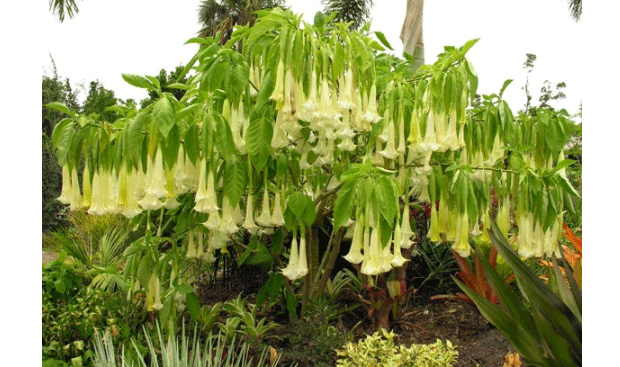
Angel Trumpet
The spectacular Angel Trumpet vine is native to the forests of South
America, and delivers a dark triad of potent toxins—atropine,
hyoscyamine, and the mind altering scopolamine. Unlike the other plants
on this list, Angel Trumpet is less dangerous in of itself, than as a
biological weapon in the hands of humans. In 2007, Angel Trumpet was
featured in the documentary “Colombian Devil’s Breath,” for its use by
criminal gang members who refined scopolamine from the ethereal looking
weed and used it to turn victims into zombies – literally. This
“hypnotizing herb” leaves its victims unaware of the nature of their
actions, but still completely conscious. The documentary contained
numerous horror stories of scopolamine attacks, including one eerie case
where a man had scopolamine powder thrown in his face, and promptly
emptied his entire apartment into the van of the robbers. Voluntary
experimenters have seriously injured themselves in their psychotic
state.
|
|
 |
|
Himalayan Blackberry
Himalayan Blackberry is one plant you don’t want to tangle
with—literally. A briar on steroids, one plant can cover half an acre
with treacherous slashers. Unlike normal blackberries, each stalk
measures up to 2 inches across, and is covered with inch long thorns
that extend like sharks teeth. While brambles might give you a scratch,
an encounter with Himalayan Blackberries may warrant a visit to the
emergency room. Slashes from even casual stumbles into the innocent
looking plants may result in serious eye injuries and blood loss from
damaged veins and arteries. Many accidents result when hikers trip in a
gully infested with the hazardous spikes. Extreme protective wear
including shatter proof safety goggles are favored by hazard management
crews. The spiked canes are placed under tension as they tangle
together, and upon disturbance, may fly back, acting as a mace capable
of slashing eyes.
|
|
 |
|
Gympie-Gympie
The Australian Gympie-Gympie tree distinguishes itself as the world’s
most dangerous tree, and the most painful of all stinging plants trees.
The Gympie-Gympie’s excruciating pain has been described as being
sprayed with hot acid, and has driven those affected to suicide. In one
disturbing case, a man shot himself after mistakenly using the leaf as
toilet paper in the bush. The terrifying tree contains one of the most
persistent toxins known to man, and burning sensations may continue up
to two years after being stung. This may be due to poison retention
inside the venomous needles injected upon contact. One researcher
discovered that the poison remains viable for up to 20 years.
Anaphylactic shock may be induced in even healthy persons, leading
Australian forestry departments to issue hazmat grade suits to bush
workers in affected areas.
|
|
 |
New Zealand Tree Nettle
The New Zealand Tree Nettle is one of only two plants in the world that
has killed a human just by the unfortunate act of walking into it. The
monster plant is an enormous and super toxic tree version of the common
stinging nettle, and may grow up to 15 feet tall. The well camouflaged
plant is armed with unusually large needles that deliver a potentially
lethal and also corrosive neurotoxin upon the slightest contact. Great
caution when hiking is critical to preventing deaths. In one tragic
documented case, a New Zealand Hunter was killed after brushing one of
these terror nettles, causing nervous system shutdown through the acute
venom effects. If death does not occur right away, potentially deadly
polyneuropathy, a degenerative breakdown of nervous system pathways may
occur over time. |
|
 |
|
Spurge Laurel
While Giant Hogweed scares with its alien appearance, we look at an
unassuming plant with small, glossy leaves that may be commonly found in
ornamental gardens and public grounds. Spurge Laurel is closely related
to the Bay Leaf, but this woody mini-shrub offers one of the dreadful
deaths in the Plant Kingdom. Containing powerful biocides, Spurge Laurel
will cause blistering and irritation if cut or handled carelessly, but
it is internally that it wreaks its havoc. Consumption of even a couple
berries will result in major internal bleeding and organ failure, with
death imminent within several hours. Interestingly, some tribes have
used Spurge Laurel as a drug of last resort for seriously infected
patients, but the cure may be worse than the disease. Wild Greenfinches
can eat it without suffering any harm.
|
|
 |